
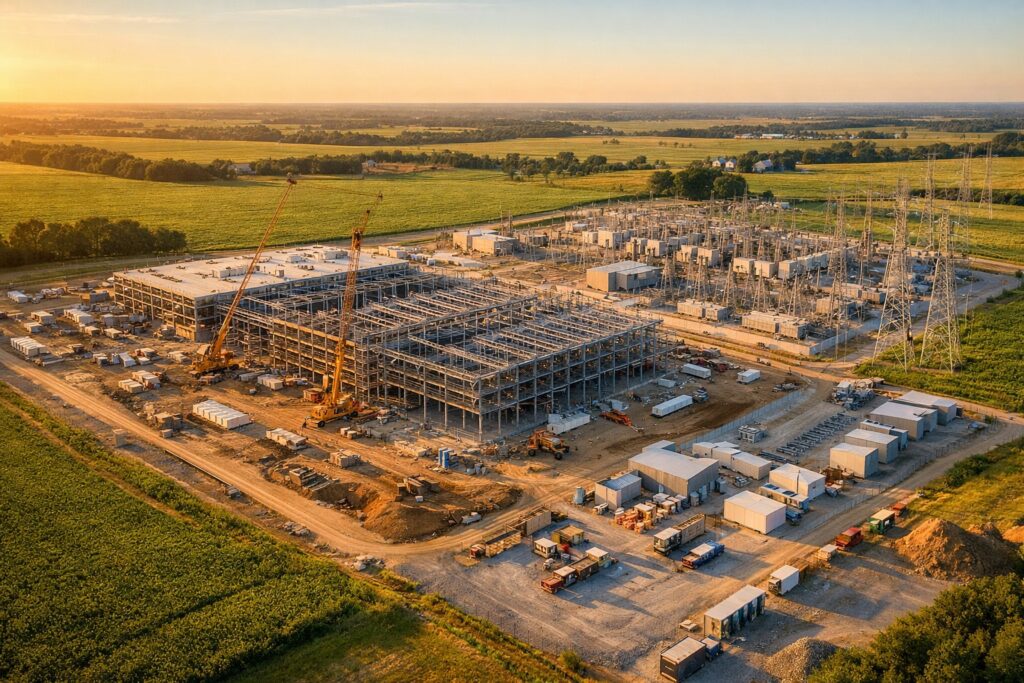
Tertiary Markets Are the New Frontier: Where Smart Money Is Building Data Centers in 2026
The data center industry has spent two decades mapping itself around a handful of dominant hubs: Northern Virginia, Silicon Valley, Chicago, Dallas–Fort Worth, Phoenix, Atlanta. Those markets built their dominance on a familiar combination of fiber density, power access, tax incentives, and skilled labor pools. They earned their status, and they remain critical.
But 2026 is exposing the limits of that model.
Primary markets are now contending with power delivery timelines stretching four to ten years, utility interconnection queues that fundamentally reshape when a project can go live, and a wave of regulatory pressure that has produced more than a dozen proposed moratoriums at the state level. Meanwhile, nearly two-thirds of new data center capacity being developed today is landing outside established hubs like Northern Virginia and Silicon Valley, a structural shift that is redefining the site selection calculus for developers, hyperscalers, and enterprise buyers alike.
Understanding which markets are rising, and why, is no longer a niche concern for real estate specialists. It is core intelligence for anyone making infrastructure decisions in 2026.
The Primary Market Squeeze Is Real
To appreciate the tertiary market opportunity, it helps to understand precisely how constrained the primary markets have become.
Cushman & Wakefield’s 2026 Americas data center report documents a market operating at historic extremes. U.S. vacancy across colocation markets sits at 3.5%, with the broader Americas at 4.2%. Colocation preleasing in the United States has reached 81.5%, meaning the overwhelming majority of space under construction is already spoken for before it opens. The Americas has 25.3 GW under construction, with Virginia alone accounting for 6.3 GW, roughly one-quarter of the entire continental pipeline.
At those utilization levels, the constraint is not demand. Demand is robust. The constraint is the ability to bring supply online fast enough, and increasingly, the ability to bring it online at all.
Grid interconnection timelines in core markets now commonly run from four to ten years, according to analysis from LVI Associates. That is not a scheduling inconvenience. It is a fundamental change in the economics of development. When a developer cannot credibly underwrite a power delivery date, the investment case unravels. As LVI frames it, the question in 2026 is no longer “what is the cheapest megawatt?” but “what is the fastest credible megawatt?” That reframing is pushing capital toward new geographies.
Regulatory pressure is accelerating that dynamic. Good Jobs First tracked 12 in-session states with filed moratorium bills as of March 2026, with at least 63 local moratorium actions introduced, considered, or adopted across towns and counties, 54 of which have already passed. Virginia, where most of the nation’s existing capacity is concentrated, has a bill (HB 1515) that would prohibit final approvals for new data center sites until specific grid-interconnection conditions are met. New York’s proposed moratorium (S9144) would impose a statewide pause while the Public Service Commission studies electricity and gas rate impacts. Georgia (HB 1012), Maryland (HB 120), Oklahoma (SB 1488), South Carolina, South Dakota, Vermont, New Hampshire, Minnesota, Michigan, and Wisconsin all have active legislative proposals that would freeze or condition new development. Denver has already enacted a local moratorium.
The pattern is consistent: in markets where data centers have concentrated, the political and infrastructure blowback is following. That friction does not disappear overnight, regardless of incentives or developer relationships.
Sightline Climate’s 2026 data center outlook puts additional pressure on the conventional pipeline picture. Of the 16 GW slated to come online in 2026, only about 5 GW is currently under construction. The remaining 11 GW is in announced stages with no visible construction progress, despite typical build timelines of 12 to 18 months. Sightline estimates that 30 to 50 percent of the 2026 pipeline will not materialize on schedule. Power bottlenecks are the primary culprit.
What Tertiary Markets Actually Offer
Cushman & Wakefield’s report is explicit about why tertiary markets are capturing growing development share: more predictable approval pathways, greater availability of developable land, and stronger appetite from local governments and utilities to accommodate large-scale projects.
That combination matters because it addresses the two variables that most consistently derail primary market deals: regulatory timeline unpredictability and power delivery uncertainty. In a tertiary market that has proactively positioned itself for data center development, a developer can often see a clearer line from site acquisition to energization than they can in a saturated hub where the utility queue stretches a decade.
Data Center Frontier’s 2026 trend analysis adds important nuance: tertiary markets do not eliminate constraints, they reintroduce them under different utility footprints. Land availability and entitlement flexibility may be strong, but grid headroom still needs to be evaluated on a market-by-market basis. The markets winning deals in 2026 are those that can demonstrate both: available land and a credible, near-term power timeline.
Area Development’s 2026 outlook frames it succinctly: markets that can demonstrate credible power timelines and coordinated permitting are separating themselves quickly. Those that cannot are being bypassed, regardless of incentives.
The Markets Gaining Momentum in 2026
Arkansas: Little Rock’s Billion-Dollar Bet
Little Rock is perhaps the most striking example of a tertiary market converting opportunity into committed capital. In January 2026, AVAIO Digital Partners announced Project Leo, a 760-acre campus in Pulaski County, 10 miles from downtown Little Rock, with an initial $6 billion investment that represents the largest economic development commitment in Arkansas history. The campus is contracted for 150 MW of power from Entergy Arkansas, energized in Q2 2027, with capacity growing toward 1 GW through subsequent phases. Total investment through full development is projected to exceed $21 billion.
The site’s selection rationale is instructive. Little Rock offers low-latency interconnection via multiple long-haul fiber routes connecting to Dallas, Atlanta, and Memphis. Arkansas passed legislation reducing regulatory timelines for new energy projects by more than half and established data center investment incentives. The site itself has existing on-site water and sewer infrastructure and natural gas access for behind-the-meter power generation. These are not secondary advantages. They are the exact variables that a developer evaluates when a primary market alternative comes with a five-year interconnection queue.
Wisconsin: Microsoft’s $13 Billion Commitment
Wisconsin demonstrates how tertiary market positioning can attract hyperscale capital at scale. Microsoft secured approval for 15 new data centers at the former Foxconn site in Mount Pleasant, with the taxable value of proposed construction surpassing $13 billion. The Foxconn site, long criticized as an economic development disappointment, is being repurposed as one of the largest single data center commitments in the Midwest.
The Microsoft Wisconsin investment reflects the logic of the current environment: a large, entitled site with existing infrastructure and utility relationships, located in a state where the permitting pathway is clearer than in Virginia or Arizona, and where the land cost and regulatory posture favor rapid development. Microsoft’s scale means it can absorb the thinner vendor ecosystem of a tertiary location in exchange for speed-to-power certainty.
Indiana: Meta’s 1 GW Campus Near Indianapolis
Meta broke ground on its second Indiana data center, a 1 GW campus in Lebanon, approximately 30 miles northwest of Indianapolis, representing a $10 billion investment. At peak, the project supports roughly 4,000 construction jobs, with 300 operational positions long-term.
Indiana’s advantage is geographic and logistical. Lebanon sits within the Indianapolis metropolitan area’s labor market, with established transportation infrastructure and utility access that supports large-load industrial development. The state has been actively competing for data center investment through tax incentives and coordinated permitting, and the Meta commitment validates that approach at the hyperscale level.
The Emerging Tier: Iowa, Kansas City, Central Washington, Pennsylvania, and the Carolinas
Beyond the headline investments, Data Center Knowledge’s emerging markets analysis identifies a broader tier of locations appearing on site-selection shortlists with increasing frequency.
Iowa and Kansas City are attracting interest for their central positioning within national fiber networks, lower land and power costs, and state-level incentive programs. Both markets offer predictable regulatory environments and utility relationships that can deliver power on compressed timelines relative to saturated coasts.
Central Washington offers the most compelling power economics in the country: 100 percent renewable energy from Columbia River hydroelectric infrastructure at some of the nation’s lowest rates. The region is already home to significant data center deployments, and its sustainability profile is increasingly relevant to hyperscalers with public net-zero commitments.
Pennsylvania has captured significant hyperscaler attention through Amazon’s build-outs in the region, bipartisan state support, a dedicated task force, and proximity to the Northern Virginia–Washington DC–New York corridor. The restart of the Crane Clean Energy Center’s Unit 1 nuclear reactor adds a reliable, carbon-free power source that strengthens the region’s long-term power security narrative.
The Carolinas, particularly North Carolina, are benefiting from Duke Energy’s aggressive data center infrastructure buildout. Duke’s data center power contracts have grown to 4.5 GW, up from 3 GW, reflecting the scale of new commitments in the region. Microsoft has signed a major agreement with Duke to power large-scale complexes under construction, and the Carolinas offer deal economics that compare favorably to Virginia while maintaining strong fiber connectivity and proximity to the Southeast corridor.
Data Center Frontier’s analysis specifically calls out Raleigh-Durham, Minneapolis, Salt Lake City, Denver, and Columbus as secondary markets combining strong fiber connectivity, moderate power availability, and proximity to population centers, locations that support repeatable deployment models for enterprise and edge-leaning use cases.
The Structural Shift Behind the Numbers
JLL’s analysis, cited by Data Center Knowledge, puts the magnitude of this shift into context: nearly two-thirds of new capacity is now being developed outside established hubs like Northern Virginia and Silicon Valley. That is not a marginal rebalancing. It represents a fundamental restructuring of where the industry is placing its bets.
Several forces are reinforcing each other to make this shift durable rather than cyclical:
Power-first site selection has changed the scoring model. When interconnection timelines and utility headroom are the primary gating factors, established hubs with saturated grids lose their traditional advantages. Markets that were historically overlooked because of thinner vendor ecosystems or less established labor markets now compete on the variable that matters most.
Moratorium risk is being priced into primary market underwriting. A developer planning a project in Virginia or New York today has to account for the possibility that the regulatory environment will change during the development cycle. That uncertainty adds risk premium to primary market investments that does not exist in states actively recruiting data center development.
Hyperscalers are leading, not following. When Microsoft commits $13 billion to Wisconsin and Meta spends $10 billion in Indiana, the vendor ecosystem, talent pipeline, and utility infrastructure investment follow. Tertiary markets that land one anchor hyperscale project tend to become materially more competitive for subsequent development.
State-level policy differentiation is accelerating. Arkansas cutting regulatory timelines by more than half, Indiana and Wisconsin offering structured incentives, and the Carolinas coordinating with utilities on power delivery create a competitive dynamic that primary markets, now contending with cost-allocation battles and moratorium proposals, cannot easily match in the near term.
What This Means for Buyers and Operators
If you are evaluating colocation options, this market structure has practical implications for your decision-making process.
Lead times and availability vary significantly by tier. Primary markets have historically offered the densest choice of facilities and the most mature interconnection ecosystems, but vacancy at 3.5 percent in the U.S. means options are constrained and pricing reflects that scarcity. Secondary and tertiary markets may offer more options at more competitive pricing, but evaluating them requires visibility across a broader geographic footprint.
Power certainty should be a due diligence priority. Whether you are evaluating a facility in a primary or tertiary market, the key question is the same: what is the power delivery timeline, and how firm is it? In a market where interconnection can slip by years, a facility with secured, near-term power availability is worth a premium over a facility with lower headline costs but uncertain energization.
Regulatory stability matters at the local level. A facility in a market with active moratorium legislation carries development risk that an operational facility does not, but that risk can still affect expansion options, provider stability, and long-term pricing. Understanding the regulatory posture of a facility’s market is now a standard element of vendor due diligence.
Total cost of infrastructure is not just $/kW. When evaluating facilities across market tiers, latency to end users, connectivity to peering points and cloud on-ramps, and the availability of carrier diversity all factor into the true cost of operating in a given location. A tertiary market facility with excellent fiber access and lower power costs may outperform a primary market option on a total-cost basis for workloads that do not require sub-5ms latency to major metros.
How GoDataCenters Helps You Navigate the Full Market
The shift toward tertiary markets creates an information challenge for buyers. Primary market comparisons are well-documented and widely published. Evaluating a facility in Little Rock against one in Ashburn or Chicago, accounting for power security, connectivity, pricing, compliance requirements, and expansion capacity, requires access to comprehensive, structured data across all market tiers.
GoDataCenters is built to give buyers exactly that visibility. Our marketplace aggregates facilities across primary, secondary, and tertiary markets, enabling you to compare providers on the variables that drive real decisions: available capacity, power commitments, connectivity options, pricing structures, and compliance certifications. Whether your workload belongs in a high-density primary market hub or a power-advantaged emerging market campus, the platform lets you evaluate the full range of options against your specific requirements, without starting from a constrained shortlist.
The frontier is moving. The data centers being built in Arkansas, Indiana, and Wisconsin today are not consolation prizes for buyers who couldn’t find space in Virginia. They are purpose-built, hyperscale-grade infrastructure positioned to serve the next decade of demand, at terms that primary markets increasingly cannot offer.
Search and compare data center facilities across all U.S. markets on GoDataCenters.com. See available capacity, review power and connectivity specs, and find the right fit for your workload, regardless of which tier the right answer comes from.
Sources: Cushman & Wakefield Americas Data Center Market Update | Good Jobs First Moratorium Tracker | Sightline Climate Data Center Outlook | Data Center Knowledge: Emerging Markets 2026 | Data Center Knowledge: March 2026 Developments | Arkansas EDC: AVAIO Digital Little Rock | Data Center Frontier: Eight Trends 2026 | Area Development: 2026 Data Center Outlook | LVI Associates: Power-Ready Site Selection 2026