
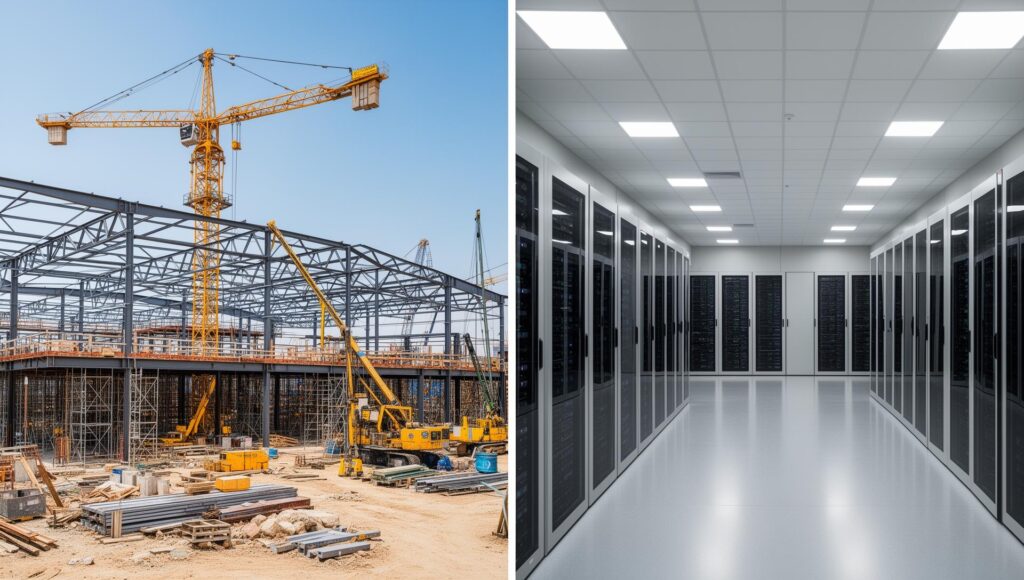
One of the most consequential infrastructure decisions an organization can make is whether to lease colocation space or build its own facility. Get it right, and you gain a durable competitive advantage in cost, performance, and scalability. Get it wrong, and you face years of overcapacity costs, infrastructure constraints, or an asset that no longer fits your operational model.
The colocation versus build-to-suit question has no universal answer, but it does have a structured framework. Here is how to evaluate it.
The Core Trade-Off
At its simplest, the choice between colocation and build-to-suit is a trade-off between control and speed on one side and capital efficiency and flexibility on the other.
Colocation offers access to existing, operational infrastructure, often deployable within weeks. Build-to-suit (or greenfield development) delivers a facility precisely engineered to your specifications, but requires 24–48 months of development time and significant upfront capital.
Neither model is inherently superior. The right choice depends on your organization’s scale, growth trajectory, financial model, and strategic priorities.
When Colocation Is the Right Answer
Colocation makes sense in a wide range of scenarios. It is often the preferred path for organizations that:
- Have near-term capacity requirements: Colocation space can be provisioned in weeks rather than years. If your compute or storage needs are pressing, the development timeline for a build-to-suit facility is simply not compatible with your business timeline.
- Require capital efficiency: Colocation converts a large, illiquid capital expenditure into a predictable operating expense. For organizations focused on capital allocation, this is a meaningful advantage.
- Need proven connectivity ecosystems: Established colocation facilities, particularly carrier-neutral data centers, offer dense ecosystems of network providers, cloud on-ramps, and peering partners that would take years to replicate in a new build.
- Are scaling in phases: Colocation operators can typically accommodate phased expansion within a facility, allowing you to scale capacity incrementally as demand grows.
- Operate workloads with variable demand: Cloud-adjacent or burst workloads that fluctuate seasonally or by business cycle are well-suited to colocation’s flexible commitment structures.
When Build-to-Suit Is the Right Answer
Greenfield development and build-to-suit construction make sense for organizations with a specific and durable set of requirements:
- Large-scale, long-term compute requirements: At sufficient scale, typically 20 MW and above, the economics of ownership can become compelling compared to long-term colocation lease costs.
- Specialized infrastructure requirements: Some workloads require infrastructure configurations that are not available in existing colocation facilities: specific liquid cooling architectures, non-standard power configurations, specialized physical security requirements, or extreme power density deployments.
- Data sovereignty and compliance mandates: Certain regulated industries (defense, intelligence, some healthcare applications) require dedicated, controlled facilities with specific security clearances, air-gapped networks, or supply chain verification requirements.
- Strategic asset ownership: Some organizations treat data center infrastructure as a strategic competitive asset and prefer ownership to tenancy.
Cost Comparison Framework
Colocation costs to model:
- Monthly recurring charges: power (per kW), space (per cabinet or per square foot), and cross-connects
- Network costs: carrier contracts, cloud connectivity, bandwidth
- Remote hands and managed services fees
- Escalation provisions (typically 2–3% annually)
Build-to-suit costs to model:
- Land acquisition and site preparation
- Construction cost (typically $8–14M per MW in current market)
- Mechanical and electrical systems
- Fit-out and commissioning
- Ongoing operational costs: staffing, maintenance, utilities
- Financing costs and opportunity cost of capital
The break-even analysis typically shows:
- At less than 5 MW: Colocation is almost always more economical
- At 5–20 MW: Hybrid approaches often provide the best economics
- Above 20 MW: Build-to-suit economics become competitive for organizations with stable 10+ year demand profiles
Timeline Considerations
| Approach | Typical Timeline |
|---|---|
| Existing colocation (on-net) | 2–8 weeks |
| Colocation buildout (new cage/suite) | 8–16 weeks |
| Wholesale lease in existing shell | 3–6 months |
| Build-to-suit (powered shell available) | 12–18 months |
| Build-to-suit (greenfield, new development) | 24–48 months |
| Build-to-suit with power constraints | 36–60 months |
In markets where power availability is constrained, which today includes most tier-one U.S. markets, greenfield development timelines are routinely extended by grid interconnection delays.
The Hybrid Model: A Practical Middle Path
Many large organizations are not choosing between colocation and build-to-suit. They are using both:
- Core workloads: Owned or long-term leased dedicated facilities for stable, high-volume compute
- Colocation: Carrier-neutral facilities for network-intensive and latency-sensitive applications
- Edge colocation: Distributed facilities for regional latency requirements
- Cloud: Burst capacity and workload flexibility
Getting the Decision Right
The colocation versus build-to-suit decision is not one-size-fits-all, and the consequences of a poor decision compound over years. The right approach combines rigorous financial modeling, a clear-eyed assessment of your organization’s growth trajectory, and access to current market intelligence on what inventory is actually available.
GO Data Centers provides free quote comparisons across 2,500+ colocation facilities and dedicated support for organizations evaluating greenfield development. Whether you need capacity in weeks or are planning a multi-year build, start the conversation at godatacenters.com.