
The data center industry is undergoing one of its most consequential transformations in decades. Across the United States, demand for compute capacity is accelerating faster than new supply can be built, power grids are being pushed to their limits, and the definition of “adequate infrastructure” is being rewritten every quarter.
For IT decision-makers and infrastructure managers evaluating data center options in 2026, the landscape has never been more complex, or more important to understand. Here are the five trends that will define where and how you source capacity this year.
1. AI and HPC Workloads Are Rewriting Power Requirements
Artificial intelligence has moved from experimental to mission-critical for a wide range of enterprises. The result: power density requirements have increased dramatically. Traditional data center designs built for 5–10 kW per rack are becoming obsolete for AI and high-performance computing (HPC) workloads. GPU-dense deployments now routinely require 30 kW, 50 kW, or even 100 kW per rack, a 5–10x increase over legacy infrastructure.
This shift is not incremental. Hyperscalers and enterprise AI teams are competing for a finite pool of power-dense, GPU-ready colocation space. The U.S. data center industry currently supports approximately 45 GW of total installed capacity, and growth projections remain at roughly 15% annually, but AI-ready inventory represents a much smaller subset of that total.
Organizations sourcing AI infrastructure need to move with urgency and precision. Waiting for the right facility to appear on a generic listing site is no longer a viable strategy.
2. Power Density and Cooling Innovation Are Inseparable
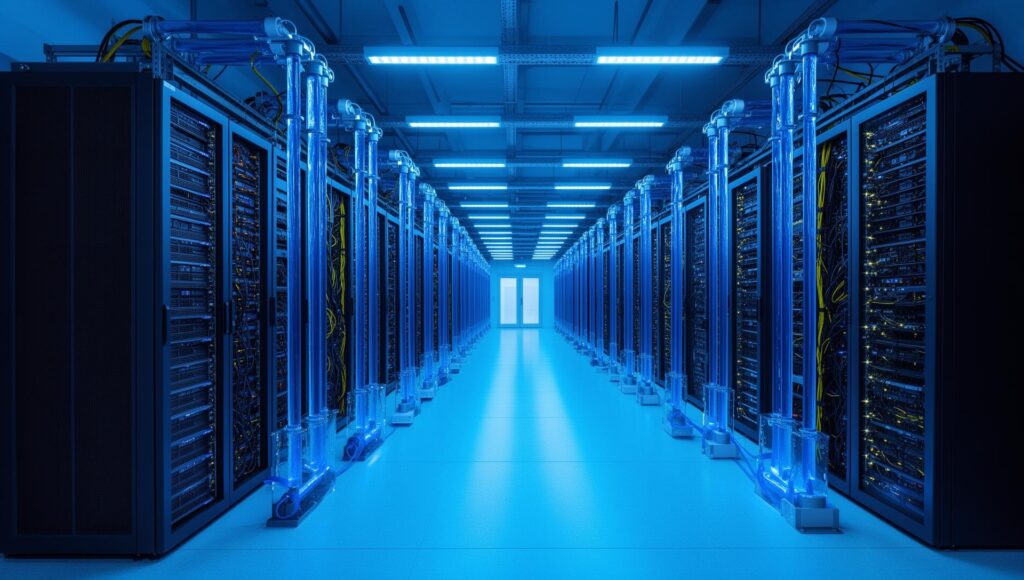
High-density AI racks generate heat that air cooling simply cannot manage at scale. Liquid cooling (including direct-to-chip, rear-door heat exchangers, and full immersion systems) has shifted from a niche solution to a mainstream requirement for GPU clusters.
The facilities that can support true liquid cooling infrastructure are a subset of an already constrained market. When evaluating data center options, operators must go beyond asking whether liquid cooling is “available” and instead verify:
- The facility’s liquid cooling delivery infrastructure (CDUs, manifolds, leak detection)
- The maximum kW per rack the facility can sustain with liquid cooling active
- Whether the facility has experience operating at high densities with real GPU workloads
- The cooling redundancy architecture (N+1 at minimum for mission-critical AI deployments)
3. Sustainability Mandates Are Now Procurement Requirements
What was once a corporate social responsibility checkbox has become a hard procurement requirement for many enterprise and hyperscale buyers. Major technology companies have committed to 100% renewable energy matching and net-zero operational carbon targets, and those commitments cascade down to their infrastructure suppliers.
The U.S. data center industry currently averages 68% renewable energy across facilities. That average masks significant variation: some markets and operators are at or near 100%, while others lag considerably. For organizations with sustainability reporting obligations, particularly those subject to SEC climate disclosure rules or EU taxonomy alignment, sourcing from the right operator in the right market is no longer optional.
Location-based renewable energy availability, Power Purchase Agreements (PPAs), and operator-level sustainability certifications (LEED, Energy Star, ISO 50001) are now standard items on the data center RFP.
4. Edge Computing Is Creating Demand in New Markets
The consolidation of workloads into a handful of tier-one data center markets (Northern Virginia, Silicon Valley, Chicago, Dallas) is giving way to a more distributed model driven by edge computing, low-latency application requirements, and regional data sovereignty mandates.
Edge deployments (whether in secondary markets, on-premise, or in carrier-neutral edge facilities) are growing in relevance for:
- Real-time industrial automation and IoT processing
- Financial services applications requiring sub-millisecond latency
- Healthcare data residency and compliance requirements
- Content delivery and streaming media optimization
For infrastructure teams, this means evaluating not just a single flagship facility but a network of connected deployment points. The sourcing process needs to account for geography, connectivity ecosystems, and local power markets simultaneously.
5. Supply Chain Constraints Are Tightening Lead Times
Transformer shortages, generator lead times, and semiconductor supply constraints are extending data center construction and fit-out timelines across the industry. New build projects that once took 18–24 months to deliver are now routinely running 36 months or longer in constrained markets.
For organizations with near-term capacity requirements, this has two implications. First, existing colocation inventory, particularly in strong markets, is at a premium and often requires direct access to off-market opportunities to secure. Second, for organizations considering build-to-suit or greenfield development, engaging development partners early in the planning process is essential to locking in critical long-lead items.
Making Sense of a Complex Market
Navigating these five trends simultaneously requires more than a Google search. It requires access to comprehensive, current inventory data, and in many cases, confidential engagement with operators who do not publicly list their available capacity.
GO Data Centers gives you access to 2,500+ facilities across all 50 states, with dedicated sourcing support for requirements 5 MW and above. Start your search or submit a confidential sourcing request at godatacenters.com.