
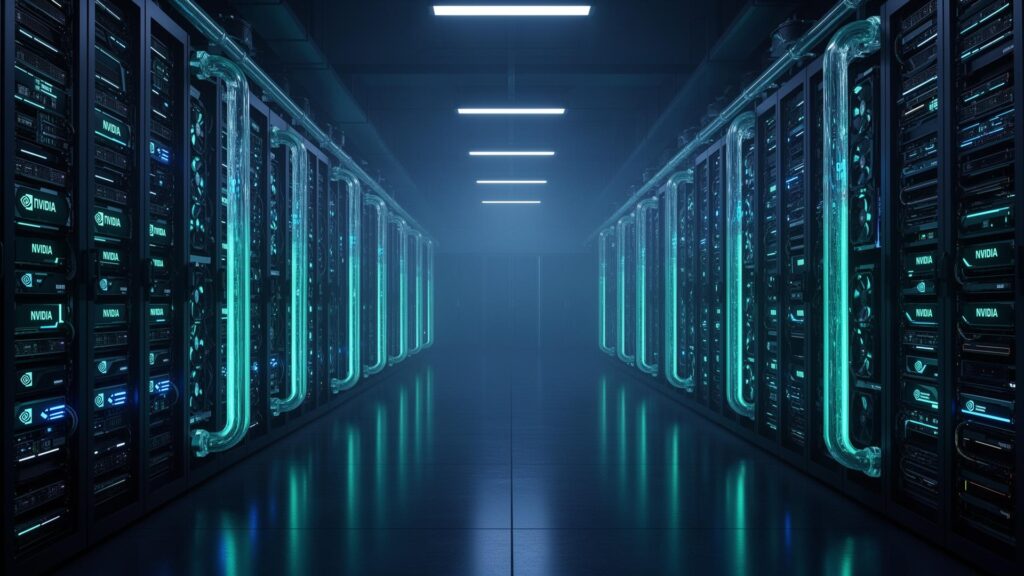
An AI-ready data center is a facility purpose-built to handle the extreme power density, thermal output, and networking demands of artificial intelligence workloads. Unlike traditional data centers designed for 5-10kW per rack, AI-ready facilities support 20-100kW per rack through liquid cooling, redundant power infrastructure, and non-blocking network fabrics like InfiniBand or Ultra Ethernet.
The artificial intelligence boom has fundamentally broken traditional data center design. When your company’s AI training cluster demands 50-100kW per rack (ten times the power draw of legacy infrastructure), standard air cooling fails. Servers thermal throttle. Power distribution overloads. Network latency kills model convergence. Teams that rushed to deploy AI workloads on conventional colocation facilities discovered too late that they’d invested millions into hardware that couldn’t reach its performance potential.
This is not a theoretical problem. It’s happening right now in every major market. Primary data center markets hit a historic low of 1.4% vacancy at year-end 2025, forcing enterprises to rent expensive interim capacity or wait 4+ years for grid connections to new builds. Meanwhile, the global data center colocation market is growing at 14.4% annually, projected to reach $204.4B by 2030, almost entirely driven by AI infrastructure demand.
The question enterprises face isn’t whether they need AI-ready capacity. It’s whether they can find it, afford it, and deploy to it before their competitors do.
This guide defines what makes a data center truly AI-ready, explains why conventional facilities fail under AI workloads, and shows you how to evaluate facilities against a real standard.
What Makes a Data Center AI-Ready?
An AI-ready data center isn’t just a traditional facility with more power outlets. It’s a purpose-built infrastructure designed from the ground up to handle the unique demands of artificial intelligence workloads.
Power Density is the starting point. Traditional data centers operate at 5-10kW per rack. AI-ready facilities must support 20-100kW per rack, with some cutting-edge deployments exceeding that. This isn’t a linear increase: it’s a fundamental shift in how infrastructure is architected. Every component downstream from the power meter must be redesigned: distribution infrastructure, cooling systems, cable management, and even building structure itself.
Liquid Cooling is no longer a premium feature for AI-ready facilities. It’s mandatory. Air cooling hits a hard ceiling around 40kW per rack. Beyond that, direct-to-chip liquid cooling or immersion cooling becomes physically necessary.
Network Fabric is the third pillar. AI workloads require non-blocking, ultra-low-latency interconnects. Traditional Ethernet top-of-rack switches create bottlenecks at the spine. AI-ready facilities deploy InfiniBand, Ultra Ethernet Consortium (UEC) technologies, or custom leaf-spine architectures designed to eliminate congestion.
Power Redundancy and Conditioning must be designed for AI workload patterns. Training clusters don’t scale gradually. They come online in discrete, massive power draws. A single GPU cluster can demand a 5-10MW surge in seconds.
Security and Compliance matter in ways that differ from traditional colocation. AI models are high-value IP. Training clusters generate proprietary data. AI-ready facilities implement air-gapped networking zones, hardware security modules, and audit trails at the infrastructure level.
When all five of these elements are present (power density, liquid cooling, network fabric, power conditioning, and security infrastructure), you have a true AI-ready data center.
How Much Power Does an AI Server Rack Need?
This is the question that separates AI-ready facilities from everything else.
A traditional server rack draws 5-10kW. It might hold 8-10 dual-socket x86 servers with reasonable CPU utilization. Cool it with passive room airflow. Power it with commodity PDUs.
An AI training rack is a different species entirely.
GPU-Dense Training Clusters typically pack 8-16 H100 or H200 GPUs per rack. A single H100 draws 700W under full load. Eight H100s = 5.6kW just for GPUs, before you add CPUs, memory, network interfaces, and power conversion losses. Real-world training clusters operate at 50-100kW per rack, sustained, 24/7. Some of the largest training runs hit 150kW+ per rack.
Inference Clusters are less demanding but still far exceed traditional capacity. A serving rack running inference workloads on GPUs typically draws 20-30kW minimum, often higher at high throughput. Inference is also different in pattern: rather than a sustained draw, inference creates bursty load spikes.
The practical implication: If you’re deploying AI at any scale, you need 20kW minimum per rack. If you’re training, you need 50-100kW. Traditional data centers can’t support either.
Why Liquid Cooling Is No Longer Optional for AI Workloads
Air cooling is dead for AI. Here’s why.
To remove 80kW of heat using air at a 20°C differential, you need to move about 12,000 CFM through a 42U rack. That velocity exceeds what you can achieve without structural damage to equipment. Liquid cooling solves this because water has 3,500x the heat capacity of air.
Three Liquid Cooling Architectures for AI Facilities:
Rear-Door Heat Exchangers are the entry point. Mount a liquid cooling loop at the rear of the rack. Works up to about 40-50kW per rack. It’s a transitional solution.
Direct-to-Chip Liquid Cooling is the production standard for high-density AI. Pump coolant directly to the GPU die through cold plates. Above 50kW per rack, this is the only cooling method that works reliably.
Immersion Cooling submerges servers entirely in non-conductive fluid. Most efficient approach but requires complete redesign of how equipment is deployed. Growing in popularity for mega-scale deployments.
AI-ready facilities typically achieve PUE of 1.2-1.4 with liquid cooling, compared to 1.7-2.2 for air-cooled facilities handling equivalent heat density.
What Network Fabric Does an AI Data Center Require?
Network fabric is often overlooked in AI infrastructure discussions. It shouldn’t be. It’s the difference between a cluster that trains in days and one that trains in weeks.
Why Traditional Ethernet Fails: AI workloads are fundamentally East-West (GPU-to-GPU, GPU-to-GPU-to-disk), with terabits of data moving between servers in the same cluster. Traditional 25GbE creates bottlenecks at the spine. When 128+ GPUs train a model, all-to-all communication patterns create congestion.
InfiniBand has been the standard for HPC for two decades. Microsecond-scale latency, non-blocking switching, and hardware-based congestion management. The latest NDR400 generation provides 400Gbps throughput.
Ultra Ethernet Consortium (UEC) is a newer initiative backed by hyperscalers to create vendor-agnostic, standards-based ultra-low-latency Ethernet designed for AI from the ground up. The industry is transitioning toward UEC for new deployments.
How GoDataCenters’ AI-Readiness Score Helps Buyers Find the Right Facility
One of the biggest challenges in the current market is opacity. How do you evaluate whether a facility is actually AI-ready?
GoDataCenters addresses this with an AI-Readiness Score: a transparent evaluation of whether a facility meets the technical requirements for AI workloads.
What the Score Measures:
- Power Density: Can the facility provision 20kW minimum per rack? 50kW? 100kW+?
- Cooling Capacity: Air-only (fails), rear-door heat exchangers (baseline), direct-to-chip liquid (high), immersion (maximum)
- Network Fabric: InfiniBand, UEC, or only traditional Ethernet?
- Power Conditioning: UPS switchover time, voltage regulation precision, distribution redundancy
- Security and Isolation: Air-gapped networking, HSMs, audit trails
- Expansion Capacity: Path to 1,000+ kW deployment, grid headroom, physical space
When you find AI-ready facilities near you, you’re comparing apples to apples. You can see exactly what power is available, what cooling is installed, and what network capabilities exist.
Why Tier-2 Markets Are Becoming the Preferred Location for AI-Ready Facilities
If you’re hunting for AI-ready capacity in a primary market (Northern Virginia, the Bay Area, Frankfurt), you’re competing for scraps.
Primary market vacancy fell to 1.4% at year-end 2025. Grid-connection wait times exceed 4 years. Available power is allocated to hyperscale operators under long-term contracts. The cost premium: primary markets average $184/kW/month vs. $135/kW/month in Tier-2 markets.
Why Tier-2 Markets Attract AI Infrastructure:
Power Availability: Lower grid utilization and faster expansion timelines. A new build that would wait 4 years in Northern Virginia might achieve grid connection in 12-18 months in Austin or Dallas.
Real Estate Economics: Land and construction costs are significantly lower. That delta compounds across a multi-facility footprint.
Tax Incentives: Texas, North Carolina, and Arizona offer significant abatements and incentive packages for data center investment.
Reduced Congestion: Less oversubscription in core infrastructure means lower latency to critical cloud regions.
Neocloud revenue passed $5B in Q2 2025, up 205% year-over-year, with the majority of new deployments in secondary metros.
When you get a quote for AI-ready capacity, include Tier-2 markets in your analysis. The cost savings (often 30-40% lower than primary markets) can fund additional capacity or accelerate your timeline.
FAQ: AI-Ready Data Centers
Q: What is an AI-ready data center?
An AI-ready data center is a facility purpose-built to handle AI workloads’ extreme power density, thermal output, and networking demands. It supports 20-100kW per rack, deploys liquid cooling systems, uses non-blocking network fabrics like InfiniBand or Ultra Ethernet, and includes redundant power conditioning designed for AI workload patterns.
Q: How much power does an AI server rack need?
An AI training rack typically requires 50-100kW, sustained, 24/7. Inference clusters draw 20-30kW minimum. For reference, traditional racks draw 5-10kW. Plan for 20kW minimum per rack for any AI deployment, and 50kW+ for large-model training.
Q: Do I need liquid cooling for AI inference workloads?
For inference below 40kW per rack, advanced air cooling with rear-door heat exchangers can work. Above 40kW, liquid cooling becomes necessary. Most production inference deployments use at least hybrid liquid cooling because cooler chips clock higher and reduce overall facility power consumption by 30-40%.
Q: What certifications should an AI-ready data center have?
Look for Tier III or Tier IV uptime certification (TIA-942), SOC 2 Type II compliance, and industry-specific certifications (HIPAA for healthcare AI, PCI-DSS for payment data). GoDataCenters publishes AI-Readiness Scores alongside certifications for transparency into actual technical capabilities.
Q: What is the difference between a regular data center and an AI-ready one?
Regular data centers support 5-10kW per rack, use air cooling, and deploy standard Ethernet. AI-ready facilities provide 5-20x higher power density, liquid cooling, specialized network fabrics for GPU-to-GPU communication, and power distribution engineered for spiky AI workload patterns. It’s a complete architectural shift.