
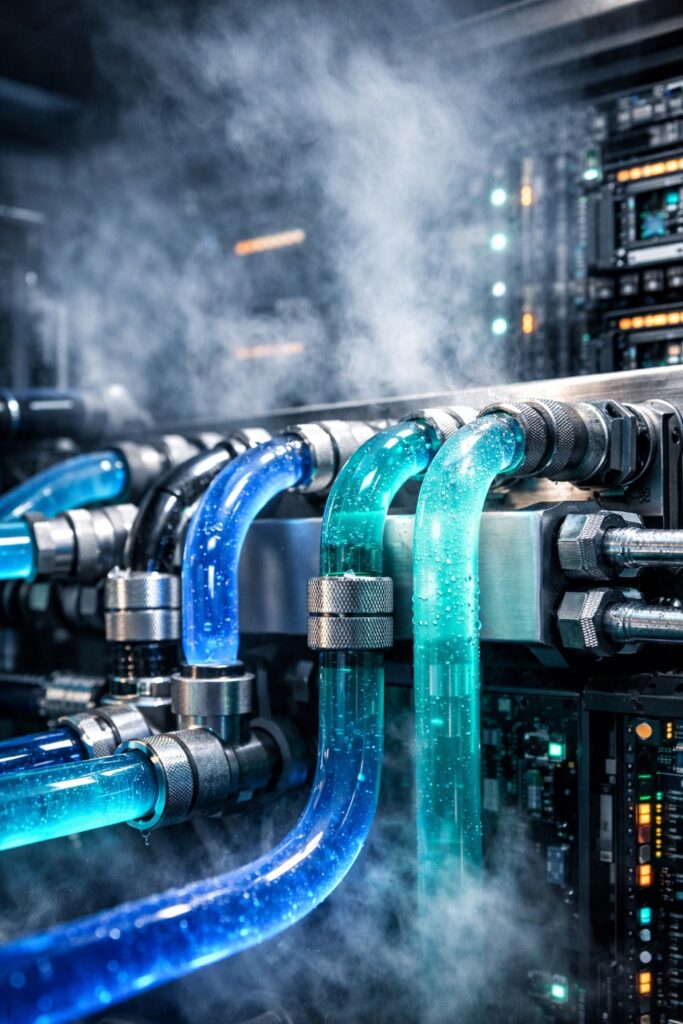
Liquid Cooling Is No Longer Optional: What Enterprise Buyers Need to Know About High-Density Colocation in 2026
Not long ago, a data center that could deliver 10 kW per rack was considered high-density. Today, a single Nvidia GB200 NVL72 rack pulls 120–130 kW. The next generation, Nvidia’s Vera Rubin NVL144, targets 600 kW per rack.
Air cooling was optimized for an era of 8–12 kW racks. That era is over.
For enterprise buyers sourcing colocation for AI and GPU infrastructure, the cooling question is no longer a footnote in an RFP. It is the central evaluation criterion. Providers that cannot support liquid cooling at meaningful density will become functionally unusable for AI workloads, regardless of how competitive their pricing looks on paper.
This guide breaks down how the two dominant liquid cooling approaches compare, what to look for in a provider’s cooling roadmap, and how to apply a practical evaluation framework before you commit to a facility.
Why Air Cooling Has Hit a Wall
The physics are straightforward. Water conducts heat roughly 25 times more effectively than air at rest, and the gap widens when both are in motion. At the rack densities AI workloads demand, air cooling does not just become less efficient. It fails operationally. H100 GPUs throttle to a fraction of rated clock speed within seconds under inadequate cooling. One throttled chip can stall an entire distributed training job.
The trajectory of GPU power draw illustrates the problem. Nvidia’s A100 (2020) drew 400 W per chip; the H100 raised that to 700 W; the B200 now sits at 1,000 W. Average rack power density more than doubled in two years, from 8 kW to 17 kW, and is projected to reach 30 kW by 2027 for general workloads, with AI training racks already well ahead of that threshold.
The colocation market is responding. Only 45% of data centers now run purely on air cooling, down from 48% in 2024, according to a November 2025 S&P Global 451 Research survey. The remaining 55% have introduced some form of liquid cooling, or are actively planning to. The liquid cooling market itself nearly doubled in 2025 to nearly $3 billion and is forecast to reach $7 billion by 2029, according to Dell’Oro Group.
The Two Technologies You Need to Understand
Enterprise buyers evaluating colocation providers for AI workloads will encounter two primary liquid cooling architectures. Understanding the trade-offs between them shapes everything from facility selection to hardware procurement.
Direct Liquid Cooling (DLC)
Direct liquid cooling, also called direct-to-chip (DTC) cooling, routes coolant through cold plates with copper or aluminum microchannels mounted directly to processors. The coolant absorbs heat at the source and carries it away through a coolant distribution unit (CDU) that interfaces with the facility’s chilled water loop.
DTC commands roughly 47% of the AI data center liquid cooling segment and is the technology Nvidia specifies for its GB200 compute nodes. The GB200’s architecture is hybrid by design: compute processors and network switch ASICs are liquid-cooled, while storage and ancillary components remain air-cooled.
The practical appeal for colo buyers is compatibility. Unlike immersion, DLC works with existing chilled water infrastructure, deploys rack by rack, and requires no facility rebuild, purpose-built tanks, or modified server form factors. A facility can introduce DLC zones without overhauling the rest of the building. This makes it the most realistic near-term upgrade path for retrofit-capable colocation providers.
DLC handles rack densities up to approximately 100–175 kW, a range that covers the current generation of AI compute racks and the majority of enterprise GPU deployments. It also enables warm-water cooling: Nvidia’s Vera Rubin processor supports liquid cooling at a 45°C supply temperature, which allows dry coolers using ambient air to bypass mechanical chillers entirely, significantly reducing energy costs.
Key limitation: DLC only addresses the components it directly contacts, typically 70–75% of rack heat. The remainder still requires air management.
Immersion Cooling
Immersion cooling submerges entire servers in tanks of dielectric fluid. Single-phase systems use fluid that remains liquid throughout the process, capturing close to 100% of IT heat and eliminating fans entirely. PUE ranges from 1.02 to 1.10 for single-phase systems; two-phase immersion achieves 1.01 to 1.03, the best of any cooling approach.
The density ceiling is dramatically higher. Single-phase immersion systems consistently support 200 kW per rack. Two-phase systems (which use boiling and condensation) support 150–250+ kW per rack, and some configurations go further.
Immersion is the right answer for the most extreme density scenarios, particularly greenfield builds designed from the ground up for frontier AI clusters. Operators like Submer have positioned immersion as a core competency for next-generation AI infrastructure, and the immersion cooling segment is projected to grow at a 34.1% CAGR through 2033.
Key limitations: Immersion requires purpose-built tanks, modified fanless servers, and dedicated floor space. It is not a retrofit technology in most facilities. Two-phase systems face an additional headwind: the primary fluorocarbon fluid supplier, 3M, has exited production of PFAS-based products, and tightening PFAS regulations in both the EU and US create long-term procurement and compliance risk for two-phase deployments.
Cooling Technology Comparison
| Factor | Direct Liquid Cooling (DTC) | Single-Phase Immersion | Two-Phase Immersion |
|---|---|---|---|
| Rack density supported | Up to ~175 kW | Up to ~200 kW | 150–250+ kW |
| PUE range | 1.02–1.03 (partial) | 1.02–1.10 | 1.01–1.03 |
| Retrofit-compatible | Yes | No | No |
| Servers need modification | No | Yes (fanless) | Yes (fanless) |
| Primary fluid | Water/glycol | Dielectric oil | Fluorocarbon (PFAS) |
| PFAS regulation risk | None | Low | High |
| Current deployment share | ~47% of liquid-cooled AI capacity | Growing | Limited |
| Best fit | Hybrid AI workloads, GB200 clusters | Greenfield AI factories | Specialized HPC |
What Hyperscalers Are Telling the Market
Hyperscaler behavior is a leading indicator for enterprise colocation requirements. When the largest operators make structural infrastructure commitments, the standards they set tend to flow downstream to the broader market.
Microsoft committed in August 2024 to move all new data center designs to closed-loop, zero-water-evaporation liquid cooling, saving more than 125 million liters of water per facility per year. Meta invested $800 million in a liquid-cooled AI data center in Indiana and debuted a 140 kW liquid-cooled rack at OCP Global Summit 2024. Google has run liquid cooling across more than 2,000 TPU pod deployments at gigawatt scale for seven years, achieving twice the chip density of comparable air-cooled systems.
Combined, the Magnificent 7 committed $650 billion by 2026 for AI infrastructure, a 71.1% year-over-year capex increase. That capital is flowing into facilities where liquid cooling is table stakes, not a premium option.
The colocation sector is absorbing this signal. A significant and growing portion of liquid cooling market revenue is now tied to colocation facilities purpose-built to support AI workloads, according to Dell’Oro Group. Providers without a credible liquid cooling roadmap are watching enterprise AI buyers move toward those that do.
What to Look for in a Provider’s Cooling Roadmap
Many colocation providers now claim “AI readiness.” The marketing language is not always matched by the infrastructure. A cooling roadmap evaluation should go beyond marketing collateral and get specific about capabilities, timelines, and contractual protections.
Current Delivered Density
Ask what power density the provider can deliver today, not what the facility was designed for, and not what’s theoretically possible in a future expansion. A facility might have a high-density zone capable of 50 kW per rack while the rest of the building sits at 8–12 kW. Understand where you would actually be deployed and what the committed per-rack power ceiling is.
Organizations deploying AI infrastructure should assess whether the provider can sustain 40–80 kW per rack as a practical baseline, with headroom for next-generation hardware.
Liquid Cooling Infrastructure Type
Has the provider installed CDUs, manifolds, and secondary fluid loops, or are they simply providing cold water to a floor stub and expecting you to figure out the rest? The best providers offer cooling-as-a-service with integrated CDUs, manifolds, and monitoring, not just raw chilled water. Ask specifically:
- What cooling technology is installed in the high-density zone (in-row, rear-door, DTC, immersion)?
- What supply water temperature do they deliver, and can they achieve 25°C or below for DGX-class workloads?
- Is there N+1 cooling redundancy with automatic failover?
Cooling SLAs
Supply water temperature must stay within 1°C of specification for AI workloads. Flow rate guarantees on a per-rack basis are not a luxury. They are a reliability requirement. Thermal SLA breaches should carry financial penalties to align provider incentives with your uptime needs.
Roadmap Transparency and Capital Commitment
Ask for the provider’s capital expenditure plan for cooling infrastructure over the next 24–36 months. A provider without a funded cooling upgrade plan is not a credible long-term partner for AI workloads. Look for:
- Named vendors or technology partners (DLC integrators, CDU manufacturers)
- Phased deployment timelines tied to specific capacity tranches
- Documented experience with existing liquid-cooled deployments
Geographic and Energy Considerations
Cooling efficiency has a significant geographic dimension. Facilities in northern climates can achieve 6,000+ free cooling hours annually, reducing operational costs by approximately $120,000 per MW compared to facilities that depend on mechanical cooling year-round. For 24/7 inference workloads, this difference compounds materially over multi-year contract terms.
AI Readiness Evaluation Checklist
Use the following checklist when evaluating colocation providers for GPU and AI workloads. Not every criterion will be relevant to every deployment, but the items marked as critical represent minimum thresholds for high-density AI infrastructure.
Power Infrastructure
- [ ] [Critical] Delivered per-rack power density of at least 30 kW, scalable to 80 kW or higher
- [ ] [Critical] Three-phase power distribution (208V or 400V) to individual racks
- [ ] Redundant power feeds (at minimum A+B feed per rack)
- [ ] Documented available capacity in the specific zone where you’d be deployed
- [ ] PDU-level monitoring with real-time reporting
Cooling Infrastructure
- [ ] [Critical] Liquid cooling infrastructure installed and operational (not just planned)
- [ ] [Critical] CDUs deployed in or adjacent to high-density zones
- [ ] Manifolds and secondary fluid loops available for tenant-side connection
- [ ] Supply water temperature at or below 25°C (for DGX-class hardware)
- [ ] N+1 cooling redundancy with automatic failover under 30 seconds
- [ ] Maximum heat density successfully deployed (ask for reference deployments)
- [ ] Air management (containment, hot/cold aisle separation) in standard zones
- [ ] Cooling SLA with defined temperature tolerances and financial penalties
Facility Readiness
- [ ] High-density zones physically segregated from standard-density environments
- [ ] Reinforced flooring rated for immersion tank weight if applicable
- [ ] Dedicated high-density power zones with appropriate circuit protection
- [ ] Environmental monitoring at the rack level (temperature, humidity, airflow)
Commercial and Contractual
- [ ] Expansion rights written into the contract (not just verbal commitments)
- [ ] Technology refresh clauses permitting infrastructure upgrades
- [ ] Contractual power density guarantees (not just marketing claims)
- [ ] Transparent pricing for cooling-as-a-service vs. customer-supplied cooling equipment
Operational
- [ ] Documented experience with liquid-cooled deployments at comparable densities
- [ ] Named technology partners for cooling infrastructure
- [ ] Funded capital plan for cooling upgrades over next 24–36 months
- [ ] Staff trained on liquid cooling maintenance and incident response
The Risk of Getting This Wrong
The consequences of selecting a provider whose cooling capabilities do not match your hardware are not theoretical. A Fortune 500 company discovered this when their provider’s “AI-ready” facility couldn’t cool 80 kW racks, resulting in approximately $8 million in stranded GPU investments. Hardware that throttles or fails due to thermal constraints does not just waste capital. It delays model training runs, disrupts inference SLAs, and creates migration costs on top of the original deployment expense.
90% of colocation facilities cannot support modern AI infrastructure regardless of marketing claims. The gap between what providers advertise and what they can actually deliver has become the central operational risk in enterprise AI infrastructure planning.
The colocation market is tight. US colocation preleasing sits at 81.5% with Americas vacancy at 4.2%. Qualified providers, those that have genuinely invested in liquid cooling infrastructure, are operating with leverage. Buyers who wait until hardware is purchased to start the facility search will find themselves negotiating from weakness, accepting inferior cooling capabilities, or delaying deployments by 12–18 months.
How GoDataCenters’ AI-Ready Filter Helps
GoDataCenters’ marketplace gives enterprise buyers a direct path to providers with verified AI-ready infrastructure. The AI-Ready filter surfaces colocation facilities that meet high-density power and cooling requirements, so you are not manually screening hundreds of providers to find the 10% that can actually support GPU workloads.
Rather than starting with a general search and narrowing by location or price, buyers sourcing for AI infrastructure should start with the AI-Ready filter as the primary criterion. A facility that cannot support your cooling requirements at the required density is not a viable option at any price point.
From there, use the checklist above to structure your due diligence conversations. The AI-Ready filter identifies candidates; your evaluation framework separates providers with genuine capability from those whose marketing has outrun their infrastructure.
The Bottom Line
The data center industry has crossed a threshold. As Dell’Oro Group Research Director Alex Cordovil put it in January 2026: “What was once treated as an optional efficiency upgrade is now a functional requirement for large-scale AI deployments.”
Enterprise buyers have two choices: treat cooling as a primary qualification criterion from the start of the provider selection process, or discover its importance after a thermal incident has already impacted production. The checklist and evaluation framework in this guide exist to help you make the first choice before the second becomes unavoidable.
GPU workloads demand liquid cooling. The question for buyers in 2026 is not whether to require it. It is how to evaluate it systematically, contractually protect it, and find the providers that have actually built it.
Use GoDataCenters’ AI-Ready filter to start your search with providers that meet the bar. Search AI-ready colocation now →
Author: GO Data Centers Editorial | Category: Analysis